
Payday loan industry trends
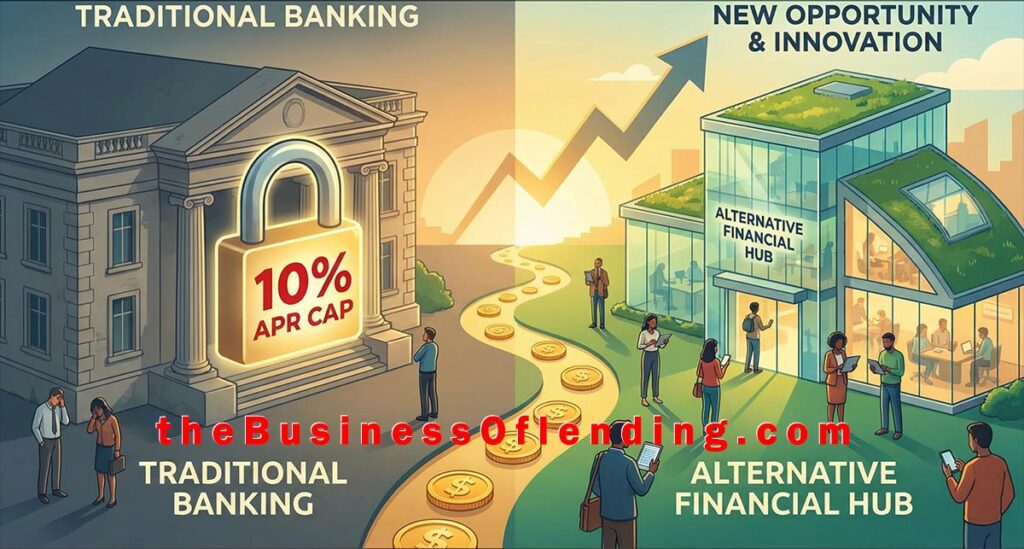
If Washington squeezes pricing power out of revolving credit, banks will not absorb the hit. They will change the rules.
That is not speculation. That is how unsecured lending works. When you cannot price for risk, you stop taking it.
President Trump has floated a one-year 10% cap on credit card APRs. Big bank CEOs are already warning what comes next: tighter underwriting, smaller lines, fewer approvals, gutted rewards programs, and less revolving access for the very consumers who use credit cards as a financial shock absorber.
Jamie Dimon says the cap could trigger a “broad-based loss of access to credit.“
Brian Moynihan says it will “constrict” card availability and balances.
They are not wrong.
But here is what they will not say out loud: when prime and near-prime credit tightens, the subprime consumer still gets a flat tire, still gets a utility shutoff notice, still needs that prescription. The need does not vanish.
It migrates.
And that migration is creating the biggest payday loan business opportunity in years.
Payday Loan Industry Trends Point to a Demand Surge in 2026
The payday loan demand and Payday loan business opportunity picture for 2026 is shaping up differently than most people expect.
While mainstream media focuses on “predatory lending” narratives, the reality on the ground tells a different story.
When banks tighten credit, alternative lenders see volume increases.
We have watched this pattern repeat at the state level for decades. Now it is about to play out nationally.
SoFi’s CEO is already positioning personal loans at 9-13% as the “transparent alternative” to 20-30% card APRs.
BNPL players are publishing repayment stats showing 96% on-time payments during Black Friday.
Afterpay says 63% of Gen Z has already moved away from credit cards.
The shift is not coming. It is here.
4 Reasons Payday Loan Demand Benefits Your Business
First, you will see more inbound demand from “banked but stressed” workers.
When card lines get slashed or applications get declined, borrowers look for speed and certainty.
That is your wheelhouse.
The customer who used to throw $500 on a Visa and worry about it later? They are coming to you now. And they still have jobs and bank accounts.
Second, this hands you a marketing narrative on a silver platter.
Consumers are being reminded, loudly, what revolving debt really costs. Your pitch just got easier:
Fixed payment. Defined term. Clear payoff date. No forever balance.
That is not just a product description. That is a campaign.
Third, you get a window to recruit higher-quality customers.
When banks tighten, you often see “new-to-you” borrowers who still have income and bank accounts but lost available credit.
These are not your typical thin-file, high-risk customers.
These are people who got squeezed by policy, not by their own behavior.
Underwrite them correctly, service them right, and they become long-term repeat customers.
Fourth, you just got more ammunition for the “rate caps reduce access” argument.
We have seen this movie at the state level. Rate caps do not create cheap credit. They create less credit. They push subprime borrowers into worse options or loan deserts.
Every academic study, every state experiment, every real-world test case proves it.
Now the federal government is about to demonstrate it on a national stage.
The Risks Alternative Lenders Need to Watch
Political heat will spread beyond credit cards. When regulators and media start asking “why is your APR so high,” they do not stop at banks.
- Tighten your disclosures.
- Clean up your advertising.
- Sharpen your complaint handling.
- Document everything.
- The spotlight is getting brighter.
Banks may launch “low-rate” products designed to look good on paper. They will market affordability while quietly shrinking approvals.
Your response: position on speed, certainty, and underwriting that actually understands the working borrower.
You are not competing on rate. You are competing for access.
Ad platforms will get stricter, not looser.
Remember Google’s lending ad limits around APR thresholds? Expect more of that.
Build channels you control:
- SEO
- Local
- Affiliates
- SMS
- Repeat-borrower reactivation.
If you are 100% dependent on paid media, you are one policy change away from a crisis.
How to Capture the Payday Loan Demand Wave
Audit your underwriting rules. Tighten what is sloppy. You are about to see new customer profiles you have not seen before. Make sure your decisioning can handle them.
Refresh your offer language. Make the promise simple: fast, transparent, and finite. No forever balances. No surprises.
Build channels you control. Organic search, local marketing, email, SMS, repeat-borrower reactivation. The paid media window is closing.
Get your compliance house in order before the wave hits. Not after.
The Bottom Line on Payday Loan Demand in 2026
Like it or not, there is a market for emergency credit.
Policy cannot be built on aspiration.
It has to be built on how people actually behave when the car breaks down on Tuesday, and payday is Friday.
Cap card APRs at 10%, and you do not create “cheap credit.” You create less credit.
That is not a problem for alternative lenders. That is the payday loan business opportunity of the decade.
If you run a disciplined operation with real underwriting, real compliance, and real collections that do not get you sued, you can catch the spillover demand and build a larger portfolio with better customers.
Do it right, and you are not the villain. You are the pressure-release valve the system needs.
Ready to Position Your Lending Business for What Is Coming?
I have spent 20+ years in the trenches of subprime lending. Operations, compliance, underwriting, collections, state licensing, the whole mess.
If you want to talk through your specific situation, book a call with me on Clarity.
Whether you are launching a new operation or optimizing an existing one, my Team and I can help you figure out how to capture the demand that is coming your way.
Begin by Grabing your copy of our eBook, “How to Loan Money to the Masses.”
Are you interested in lending in Texas? You’re in luck! Here’s EVERYTHING you need to know, Texas CAB/CSO Lending Model.
And, our “2026 Private Access Market Analysis.”
Meanwhile, go make some serious Money and be of service!
10 FAQs for this post (with answers)
What happens if credit card APRs are capped at 10%?
Most issuers will likely respond by tightening underwriting, reducing credit lines, and cutting access for higher-risk borrowers because risk-based pricing is constrained. [Link]Why would a credit card cap increase payday loan demand?
Because when mainstream revolving credit gets rationed, emergency borrowing demand does not disappear, it shifts to faster-access alternatives.Who is most likely to lose access to credit cards under a cap?
Typically, subprime and near-prime consumers are first, because their pricing is most dependent on risk-based margins. [Reuters]Would a 10% cap automatically make borrowing cheaper for everyone?
Not necessarily. If approvals and available lines shrink materially, many consumers may end up with fewer options, not cheaper options. [Reuters]How should payday and small-dollar lenders prepare for 2026 demand?
Tighten underwriting where it’s sloppy, refresh offer language around “finite payoff,” build owned channels (SEO, email, SMS), and shore up compliance before scrutiny increases.What should lenders watch out for if demand surges?
More political and regulatory heat, stricter ad platform rules, and increased complaint volume. Your disclosures and complaint handling need to be clean.Will personal loan and BNPL products also benefit?
Yes, they are positioned as “transparent alternatives,” and public commentary from SoFi’s CEO explicitly frames opportunity if card lending contracts.Is BNPL repayment actually “responsible,” or is that marketing?
Afterpay reported 96% of U.S. Pay-in-4 customers paid off Black Friday/Cyber Monday purchases early or on time (their data, so cite it as such).What’s the best marketing angle for payday/AFS operators if this cap debate grows?
“Speed, certainty, finite payoff” beats “low rate.” Your competitive edge is access and clarity, not pretending you’re a credit union. [Trihouse Consulting]Does this mean payday lenders should get sloppy because demand is coming?
No. The post’s core warning is the opposite: better customers may appear, but only disciplined underwriting, compliance, and collections convert that into durable portfolio value.