
I Made $1,095 in 82 Days Without Lending a Dollar. The Money Is Not the Point.
Last updated: August 23, 2026
Between June 1 and August 21 I earned $1,095.41 running a small-dollar loan affiliate site. 587 loan requests submitted. 470 of them bought. No license. No capital at risk. No loan book, no servicing, no collections, no bad debt. Those are the real numbers off the buyer’s own dashboard, not a screenshot from a course.
That is not a business. It is a test, and it is the cheapest one in this industry.
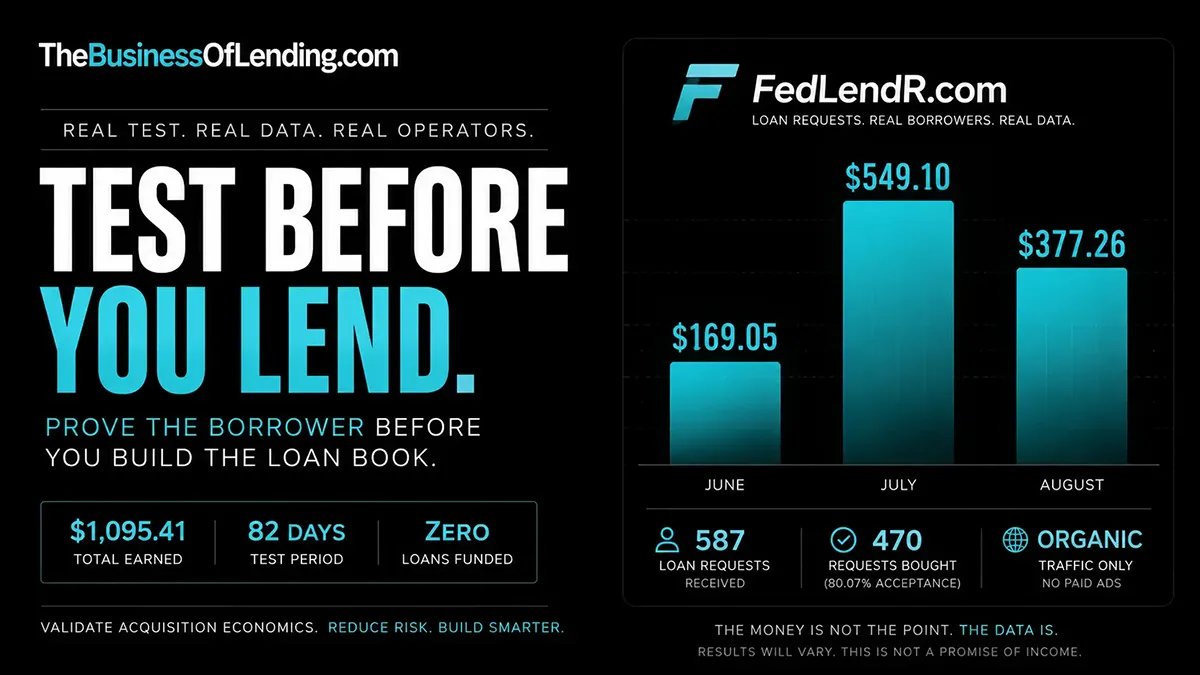
The site is FedLendR.com. It explains allotment loans to federal government and USPS employees, which are installment loans repaid through a fixed deduction taken from a federal or postal paycheck, then hands the readers who choose to apply to independent lending partners. It is not a lender and it says so on every page. I earn a fee when a submitted loan request is accepted by a buyer.
If you want the operator lesson and not the story, skip to the three things it taught me. That is where the transferable part lives.
What 82 days actually looked like
| Month | Revenue | Requests submitted | Bought | Acceptance rate | Per request submitted |
|---|---|---|---|---|---|
| June 2026 | $169.29 | 140 | 117 | 83.57% | $1.21 |
| July 2026 | $549.04 | 255 | 207 | 81.18% | $2.15 |
| Aug 1–21, 2026 | $377.08 | 192 | 146 | 76.04% | $1.96 |
| Total, 82 days | $1,095.41 | 587 | 470 | 80.07% | $1.87 |
Pulled from the lead buyer's own reporting dashboard on August 21, 2026, for FedLendR.com. August is a partial month, 21 days of 31. Revenue per request is calculated against requests submitted, not requests bought, because that is what each submission is actually worth to the publisher. One site, one niche, organic traffic only, no paid acquisition.
Read that table like an operator, not like someone shopping for a side hustle.
Revenue nearly tripled from month one to month two. Lead volume went up 82 percent. Revenue per lead went from $1.21 to $2.15, then gave back to $1.96.
And the acceptance rate fell every single month. 83.57 down to 76.04.
Three months, three different problems. That is what a real dashboard looks like.
The money is bad and that is fine
$1,095 over three months is a car payment.
Anybody selling you a course off numbers like that is selling you a dream.
Here is what those numbers actually bought me:
I learned the borrower acquisition economics of a niche with zero capital at risk and zero regulatory exposure.
I know what a federal employee borrower costs to acquire through organic search.
I know what buyers will pay for one.
I know which requests get rejected and why.
I know the spread.
If I now decide to lend into that segment myself, I am not guessing at the top of the funnel.
That is the single most expensive thing to guess at, and I bought the answer for the price of a domain and hosting.
Why almost everybody builds this backwards
The standard path into consumer lending goes like this.
- Form the entity.
- Get licensed in your states.
- Raise the capital.
- Pick a loan management system.
- Write your credit box.
- Hire or outsource collections.
- Then, at the very end, after twelve to eighteen months and a serious pile of money, you go find borrowers.
That is the moment most operators discover that borrowers cost more than they modeled, or that the leads available at their price are the ones nobody else wanted.
By then the money is spent and the entity exists and the pressure to fund something, anything, takes over.
This is where people get killed.
Not in underwriting.
Not in collections.
In acquisition math they never tested.
The gurus all sell you the build.
Nobody sells you the test, because the test is boring and it does not cost enough to be worth teaching.
Run it backwards. Prove you can put a borrower in front of an offer at a price that leaves margin. Then go build the thing that funds them.
Three things it taught me that transfer straight to a loan book
1. If you do not own the contact, you own nothing
For most of the first two months, the site sent readers straight out through a bare affiliate link.
Reader clicks, leaves, applies somewhere else, buyer pays me a couple of dollars, and I never learn who that person was.
So I put a short form on the page first.
Name, email, phone, amount, then the handoff.
Off-site clicks fell from 296 in one period to 79 in the next.
Down 73 percent. Leads per day went up 11 percent over the same stretch.
Same traffic. Same revenue.
Except now the email is mine.
The lender version of this lesson: if you buy leads and do not capture and keep the applicant’s contact information, including the ones you decline, you are paying full price for a single shot at a borrower you will never see again.
Your declines are somebody else’s approvals, and in six months a decline may be your best customer.
2. Not every lead is worth the same, and the spread is enormous
My blended rate across 82 days works out to $1.87 for every request the site submitted, rejects included.
That is the number that matters to a publisher, because you do the work on all of them and get paid on some of them.
The typical one pays under two dollars.
On one day in August I traced a revenue spike to a handful of requests that paid roughly $47 each.
Same site. Same form. Same day. A 20x spread on the identical product.
I still do not know exactly what made those requests premium.
- State?
- Requested amount?
- Time of day are the candidates I am working through.
Finding out is worth more than doubling my traffic.
The lender version: this is your credit box, discovered from the outside.
Learning which borrower profile the market pays a premium for is the same muscle as learning which borrower profile actually pays you back.
Most new lenders write a credit box from a spreadsheet. This teaches you to write one from evidence.
3. Acceptance rate is a KPI, not a footnote
Look at that column again. 83.57, then 81.18, then 76.04.
I was sending more and getting paid for a smaller share of it. Nearly a quarter of my August submissions were bought by nobody.
So I pulled a day of raw submissions and read every row.
In an 18-row sample, four were the same people submitting twice.
One resubmitted a minute later at a different amount.
One resubmitted three minutes later with the capitalization on her name changed.
That is 22 percent redundant against a 24 percent rejection rate.Close enough to test.
A duplicate blocker went on the form.
The lender version: every rejected submission is work performed for zero.
Same as an application you take in, key, pull credit on, and decline for a reason you could have screened at intake.
Rejection rate is not a number you note. It is a number you attack.
What this does not teach you
I am not going to oversell it.
Affiliate income teaches you nothing about underwriting a stranger. Nothing about collections. Nothing about servicing, state licensing, capital stacks, ACH returns, charge-off curves, or what happens the first time a borrower you liked stops answering the phone. Those are the hard parts, and this path skips every one of them.
It teaches exactly one thing: whether you can put a qualified borrower in front of an offer at a cost that leaves margin.
That happens to be the one thing most people never test, and the one that kills them.
The parts of mine that are still broken
If I stopped here you would think this went well. It went partly well.
The site sits at an average Google position of 29.31. That is page three. It earned 4,458 impressions last month and converted them into 284 clicks, and most of those clicks were people who already knew the brand name and typed it in.
Nobody on the internet has ever mentioned this brand except me, on sites I own. Search engines and AI systems both treat that as exactly what it is.
The revenue went up because I stopped leaking visitors out the side door, not because more people found me. Those are two completely different problems, and I have only solved one.
Anyone showing you a growth chart without the part that is still broken is showing you a sales page.
If you want to run the test yourself
Five steps. None of them require permission from anyone.
1. Pick a borrower you actually understand. Not a keyword, a person. I picked federal and postal employees because payroll deduction is a real mechanism I already understood. Pick where you have an edge, or you are just another affiliate site.
2. Get accepted by a lead buyer before you build anything. They have compliance requirements, prohibited language lists, and state restrictions. Read all of it first. Building the site and then discovering half your copy violates the agreement is a rebuild you paid for twice.
3. Build the smallest thing that answers a real question. Ten pages that genuinely explain the product to someone who is confused beats fifty pages of thin content aimed at search volume. Both machines and people can tell the difference now.
4. Capture the contact before the handoff. Always. This is the whole ballgame. A form on your page, then the redirect. Skip this and you are a billboard for somebody else’s business.
5. Watch three numbers, weekly. Submissions, acceptance rate, and revenue per accepted submission. Not traffic. Traffic is a vanity metric until the other three are healthy.
Total cost to find out: a domain, hosting, and however many evenings you are willing to spend. Compare that to the version where you learn the same lesson after the license and the capital call.
The rule
Prove you can get a borrower before you spend a dollar being able to lend to one.
The affiliate site is not the business. It is the receipt that says the business is worth building.
The Bible is the 500-page playbook for everything the affiliate test skips: licensing, capital, underwriting, servicing, collections, and the unit economics that decide whether any of it works.
See what is inside →Written by an operator who built and sold 15 storefront locations.
Frequently Asked Questions
Do I need a lending license to earn affiliate income from loan traffic?
No. You are not making credit decisions, funding loans, or servicing accounts, so state lending licenses generally do not apply. You do take on advertising and marketing obligations, and lead buyers impose their own prohibited-language requirements on top of federal and state advertising law. Read your buyer’s terms before you write a word, and get your own counsel on your states.
How much can a loan affiliate site realistically earn?
Mine earned $1,095.41 in 82 days on roughly 700 visitors a month. That is a small number and it should be read as one. Earnings scale with qualified traffic and with the price the buyer pays per accepted submission, and both vary enormously by niche, by state, and by borrower profile. Anyone quoting you a range without naming the traffic behind it is guessing.
What is the difference between a lead generator and an affiliate in this industry?
In practice the line is thin. An affiliate typically sends clicks and is paid on the resulting action. A lead generator captures the applicant’s information itself and sells the record. The moment you put a form on your own page, which you should, you are doing both. That changes your data handling obligations, so plan for it rather than discovering it.
Should I capture the email or just send the click?
Capture it, every time. Sending a bare click means the buyer gets a customer and you get a one-time fee. When I moved to a form-first flow, off-site clicks fell 73 percent while daily submissions rose 11 percent, and I kept the contact on every one.
Is this a good path into owning a lending business?
It is a good way to test the single most expensive assumption in the plan, which is that you can acquire borrowers profitably. It is not a substitute for learning underwriting, collections, servicing, or compliance. Treat it as the cheapest possible feasibility study, not as the business.
How long before an affiliate site earns anything?
Mine had been registered since 2023 and earned almost nothing until it was worked deliberately. Organic traffic is slow and the compounding is real but it is measured in quarters. If you need income this month, this is the wrong path.
How to Start a Subprime Lending Business
Define your lending box, your borrower, and your verification rules, then pilot before you scale.
Cost Per Funded Loan
The acquisition metric that decides whether the rest of your model survives contact with reality.
The Four KPIs That Show If You Are Actually Profitable
Charge-off by vintage, roll rate, cost per funded loan, net yield. The paper usually lies.
Proforma Financial Modeling Tool
Put your own lead costs and conversion rates in and see what the loan economics do.
Compliance and Licensing Best Practices
What you take on the moment you stop sending clicks and start making credit decisions.
Consulting With Jer
Bring your numbers. One-on-one on starting, fixing, or valuing a subprime lending business.
Figures in this article are the actual reported results from FedLendR.com, a site I own, for June 1 through August 21, 2026. They are one site in one niche and are not a projection of what any other site will earn. Nothing here is legal, tax, compliance, or investment advice. Lead-buyer agreements, advertising rules, and state licensing obligations vary; verify yours with your own counsel before you publish or apply.
Written by Jer Ayles | 20+ years in consumer lending | About Jer Ayles