
Payday Loan Franchise Cost: The $300K Mistake Hiding Behind a 20-Year-Old Brochure.
(And What Smart Entrepreneurs Do Instead)
Last updated: August 2026
A payday loan franchise runs roughly $70,000 to $440,000 in total initial investment depending on the brand and the store format, plus an ongoing royalty that can reach 6% of monthly gross receipts with a dollar floor underneath it. Before you evaluate a single one of those numbers, confirm the brand is still selling franchises at all. As of August 2026, ACE Cash Express, the name most people cite first, is listed on Franchising.com as not currently accepting new applicants, and the unit counts published next to its investment figures on franchise portals date to 2005 and 2006.
You are not looking at a business model. You are looking at a brochure that has been sitting on a shelf for twenty years.
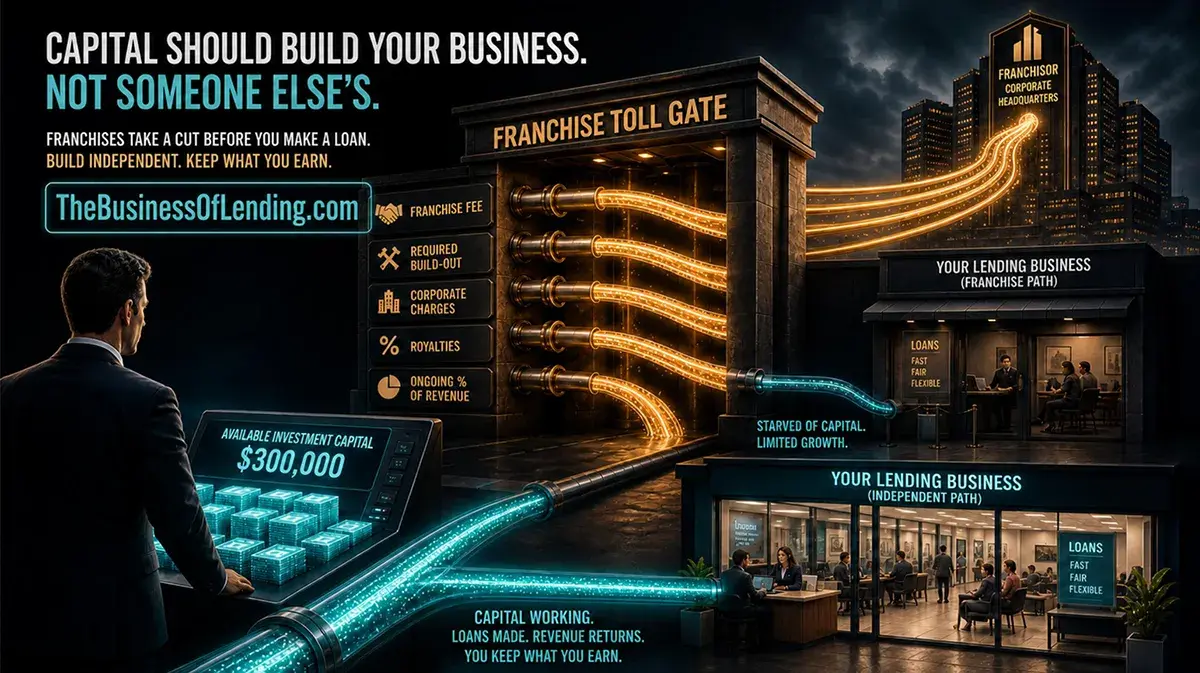
Here is the term that decides this for you. A Franchise Disclosure Document (FDD) is the disclosure a franchisor is required to hand you before you sign anything or pay anything. Item 7 is the estimated initial investment. Item 6 is every recurring fee. Item 19 is the financial performance representation, and it is optional, which is why most lending franchisors leave it thin. Item 20 lists current and former franchisees with contact information. As of August 2026 the FTC Franchise Rule requires delivery at least 14 calendar days before you sign or pay, and rules change, so confirm the current requirement at the FTC Franchise Rule compliance guide before you rely on it.
If a franchise salesperson has quoted you a number and has not handed you the FDD, you do not have a number. You have a pitch.
New to this decision? The free newsletter covers what is working and what is breaking across payday, title, and installment lending, four issues a month. The complete operator manual is The Bible.
What does a payday loan franchise actually cost in 2026?
Here is what the published figures look like, compiled August 2026 from franchisor sites and third-party franchise directories.
| Brand | Initial franchise fee | Total initial investment | Ongoing royalty | Accepting franchisees (Aug 2026) |
|---|---|---|---|---|
| ACE Cash Express (Populus Financial Group) | $30,000 full-service; $15,000 small-market or kiosk; waived on conversions | $141,650 to $279,100 depending on format | Greater of $1,000 per month or 6% of monthly gross receipts | Listed as not currently accepting new applicants |
| Cash Plus | Not published | $198,200 to $284,700 single unit (company site); $225,000 to $275,000 (directory listing) | Not published | Franchise development contact active |
| Quick Cash | $20,000 | Approximately $70,000 to $80,000 including working capital | Not published | Listed |
| Family Financial Centers | $40,500 | $95,500 to $135,500 store-in-store; $210,500 to $440,500 full single store | Not published | Actively recruiting |
Figures compiled August 2026 from franchisor websites and third-party franchise directories. Sources disagree in at least one case. Only the franchisor's current Franchise Disclosure Document is authoritative. Verify before you budget.
Now look at the Cash Plus row again.
The company’s own franchise page publishes $198,200 to $284,700 for a single unit. Franchise Gator publishes $225,000 to $275,000 for the same brand. Two published sources, two different answers, same business.
That is not a scandal. It is a signal. Third-party franchise directories are advertising, not filings. If you are building your capital plan off a directory listing, you are building it off an ad.
Only the current FDD is authoritative. Everything else is a starting point for a question.
The number nobody checks before they check the price
Everybody asks what the franchise costs. Almost nobody asks whether the franchisor is still in the franchising business.
ACE Cash Express is the brand people name in the first sixty seconds of every one of these conversations. As of August 2026, Franchising.com states ACE is not currently accepting new applicants and offers a notification signup instead. The unit data published alongside ACE’s investment figures on franchise portals is from June 2005, when 104 franchise owners ran 229 locations, and June 2006, when the system totaled 1,573 stores across 38 states.
Twenty years. Two federal rulemakings. A dozen states that repriced or banned the product. An entire migration of the business online.
The brochure did not move.
This is where people get killed. They spend three weeks negotiating a number that was set in a different regulatory era, for a store format that made sense when the customer walked in the door instead of tapping an app.
The royalty is the real price, and the floor is the part that hurts
ACE’s published royalty structure is the greater of $1,000 per month or 6% of monthly gross receipts.
Read that again. The greater of.
Run the arithmetic on your own store, not on a good one. This is arithmetic, not a projection, and it is not a forecast of what your store will do.
A location grossing $50,000 a month pays 6%, which is $3,000 a month, $36,000 a year, $360,000 across a ten-year term. That is on top of the initial investment, and it buys you nothing that shows up in your loan book.
A location grossing $10,000 a month in a slow quarter pays the $1,000 floor. That is a 10% effective royalty in the month you can least afford it.
Percentage royalties scale with you. Floors scale against you. Your worst months carry your highest effective rate, and your worst months are exactly when a new operator is deciding whether to keep going.
If you want to understand where lending margin actually leaks, start with cost per funded loan. A royalty is a permanent line item sitting on top of that number, and it never gets more efficient.
You inherit a brand and a fourteen-year-old argument you did not start
The most-cited statistic in every payday lending debate comes from a Pew Charitable Trusts report titled Payday Lending in America: Who Borrows, Where They Borrow, and Why, published July 19, 2012. It found the average borrower took out eight loans of $375 per year and carried a payday loan for five months of the year.
That research is from 2012. It is still quoted in state legislative hearings in 2026, and it is still the frame your brand will be argued inside.
When you franchise, you cannot answer that argument on your own terms. You get the franchisor’s positioning, the franchisor’s press posture, and the franchisor’s product design, whether or not it fits what you believe about the business.
Independent operators can build the answer into the product. Principal paydown inside the loan agreement. A structure that moves the borrower forward instead of parking them. A collections process you can describe out loud in a regulator’s office without flinching.
That is a positioning asset. You cannot buy it, and you cannot get it approved by corporate.
For what the political side of this looks like when it goes badly, read what a nationwide rate cap actually eliminates.
The regulation no franchise agreement can shield you from
Here is the timeline every franchise sales deck skips.
The payment provisions of the CFPB’s 2017 Payday, Vehicle Title, and Certain High-Cost Installment Loans Rule took effect March 30, 2025.
They prohibit further withdrawal attempts after two consecutive failed attempts for insufficient funds, and they require advance notice before the first withdrawal attempt plus a notice of rights after two consecutive failures.
Two days before that compliance date, the CFPB announced it would not prioritize enforcement or supervision with respect to penalties or fines tied to those provisions.
Then the CFPB’s 2026 regulatory agenda tees up a deregulatory proposed rule, expected as early as July 2026, to reconsider the remaining provisions of the 2017 rule including its compliance dates.
Effective, then unenforced, then under reconsideration. Eighteen months, three postures.
Now go read the term length on the franchise agreement in front of you.
State law moves faster and cuts deeper.
A rate structure that is legal and profitable in Texas can be illegal in Illinois, and the Texas structure itself depends on a licensing path most operators misread the first time.
If Texas is on your list, start with the Texas CAB and CSO licensing update before you sign anything with a territory clause in it.
Independent operators repriced, restructured, or exited during that window without asking anyone. Franchisees waited for a corporate bulletin.
The full operator manual covers what a franchise agreement will not: state licensing paths, underwriting rules, collections process, lead buying, KPIs, forms, and the vendor list. 500+ pages. Instant PDF. Free updates for life, plus a 30-minute Strategy Call with Jer.
See What's Inside The BibleInstant download. Free updates for life. 30-day refund.
What operators do instead: three moves
1. Put the franchise fee on the street.
A $30,000 initial fee plus the first year of royalties is capital that could be sitting in receivables earning fees from month one. It is not a rounding error against a $250,000 raise. It is the difference between funding loans in your first quarter and funding them in your third.
2. Buy the systems separately, and keep the right to fire them.
You are not paying a franchisor for magic. You are paying for a loan management system, a compliance framework, lead sources, a collections process, and vendor introductions. Every one of those is available a la carte. Every one of those can be replaced when it stops performing. That last part is the whole point. You cannot fire your franchisor.
3. Own the brand and the customer file.
Exit value in this business lives in the loan book, the customer file, and the licenses. When you franchise, the trademark is not yours, the customer relationship is contested, and the sale needs corporate consent. Build something you can actually sell.
The mechanics of the independent path, product by product and state by state, are what The Bible covers: licensing, underwriting, collections, marketing, KPIs, forms, and vendors, in one 500-plus page manual instead of eighteen months of blog posts.
If Car Title is the vertical you are looking at, start here.
When a lending franchise is actually the right call
I am not going to pretend the answer is never.
A franchise can make sense in three situations. You have capital but no appetite to build operating process from zero and you want a defined manual on day one. You need financing and the franchisor is on the SBA franchise registry, which can shorten a lender’s underwriting. Or you want an exit into a buyer pool that specifically shops franchised units.
Each of those is testable. None of them is testable from a sales call.
Item 19 tells you whether the franchisor will put its own performance numbers in writing. Item 20 gives you the phone numbers. Make the calls, and make the ones to former franchisees first. Current franchisees have a reason to sound happy. The ones who left do not.
How to vet any lending franchise in five steps
- Get the current FDD in writing. Not a summary, not a directory listing, not a slide. The document. Confirm the current delivery timing requirement at the FTC before you count days.
- Read Item 7 and Item 6 before Item 19. What it costs to open and what it costs to stay open. Those two decide the deal. The performance numbers are the last thing you read, not the first.
- Call Item 20, former franchisees first. Ask what they spent versus what Item 7 said, how long to break even, and what they would need to see to do it again.
- Model the royalty at your worst month, not your best. If there is a dollar floor, calculate the effective percentage at half your projected volume. That is the number that decides whether you survive a bad quarter.
- Price the independent path side by side. Same capital, same state, same loan product, same twelve months. Put both on one page. If the franchise cannot win on that page, it cannot win.
If you cannot complete all five, you are not ready to sign. That is not caution. That is the job.
Where to Go From Here
You have three ways to go deeper, and one way to stay current while you decide.
| Option | What it gives you | Best for |
|---|---|---|
| Free Newsletter | 4+ issues a month on what is working, what is breaking, and regulatory movement across payday, title, and installment lending | Anyone not ready to commit to a purchase or a call yet |
| Free 15-Minute Strategy Call | A no-cost, no-pitch conversation about your specific state, model, and timeline | Readers with a real launch decision in front of them |
| The Bible | The full 500+ page operator manual covering licensing, underwriting, collections, marketing, KPIs, forms, and vendor resources for every consumer loan product | Operators who want the complete playbook once, not scattered blog posts over months |
| Jer’s AI Clone | Ask lending-specific questions any time, 10 free per month, unlimited on the Insiders Club | Readers who want ongoing answers without booking a call every time |
Bring your numbers to the call. Bring the FDD too.
Your capital belongs in your loan portfolio, not in a franchisor’s operating account.
Frequently Asked Questions
How much does a payday loan franchise cost in 2026?
Published total initial investment figures range from roughly $70,000 for a small Quick Cash unit to $440,500 for a full-size Family Financial Centers store, with most brands landing between $95,000 and $285,000. Initial franchise fees run from $15,000 to $40,500. These figures were compiled in August 2026 from franchisor sites and third-party franchise directories, they change without notice, and only the franchisor’s current FDD is authoritative.
Is ACE Cash Express still selling franchises?
As of August 2026, Franchising.com lists ACE Cash Express as not currently accepting new applicants and offers a notification signup instead. The investment figures still circulating on franchise directories are published alongside unit counts from 2005 and 2006. If a broker quotes you ACE numbers, ask for a dated FDD before you spend another hour on it.
What is a reasonable royalty for a lending franchise?
There is no industry standard, and several brands do not publish the figure at all. ACE’s published structure is the greater of $1,000 per month or 6% of monthly gross receipts. The dollar floor matters more than the percentage, because it raises your effective rate in exactly the months your volume drops. Model it at half your projected volume before you sign.
Can I open a payday lending business without a franchise?
Yes. Consumer lending is licensed at the state level, not franchised, so nothing about a franchise agreement grants or speeds up a license. What a franchise sells you is process, brand, and vendor relationships, all of which can be bought separately and replaced when they stop working. The complete independent path is what The Bible walks through, state by state and product by product.
Does a franchise help with state licensing?
Not directly. Licensing requirements, bonding, net worth minimums, and examination standards are set by each state regulator and applied to your entity, not to the brand on the sign. A franchisor may supply templates and a compliance manual, which has real value, but the application, the exam, and the liability are yours. Requirements vary by state and change without notice, so confirm current rules with your state regulator or a licensed attorney before acting.
How to Start a Car Title Loan Business
The independent build for the title vertical: licensing, LTV, repossession exposure, and unit economics.
Cost Per Funded Loan
The one number that tells you whether your marketing spend is building a book or burning capital.
Texas CAB and CSO Licensing Update
What the Credit Access Business model actually requires before you sign a territory clause.
What a Nationwide Rate Cap Actually Eliminates
The regulatory risk no brand, franchised or independent, can price out of the model.
This content is general business education, not legal, licensing, or compliance advice. Franchise terms, lending laws, and rate caps vary by state and change without notice. All franchise figures cited here were compiled in August 2026 from franchisor websites and third-party franchise directories; only the franchisor’s current Franchise Disclosure Document is authoritative. Confirm current requirements with a licensed attorney or your state regulator before acting. Nothing here is a guarantee of any financial outcome. Lending carries real financial risk.
Written by Jer Ayles | 20+ years in consumer lending | Built and sold 15 storefront lending locations | About