
Texas CAB Third-Party Lender Agreements:
What Operators Must Understand Before They Sign
Last updated: July 2026
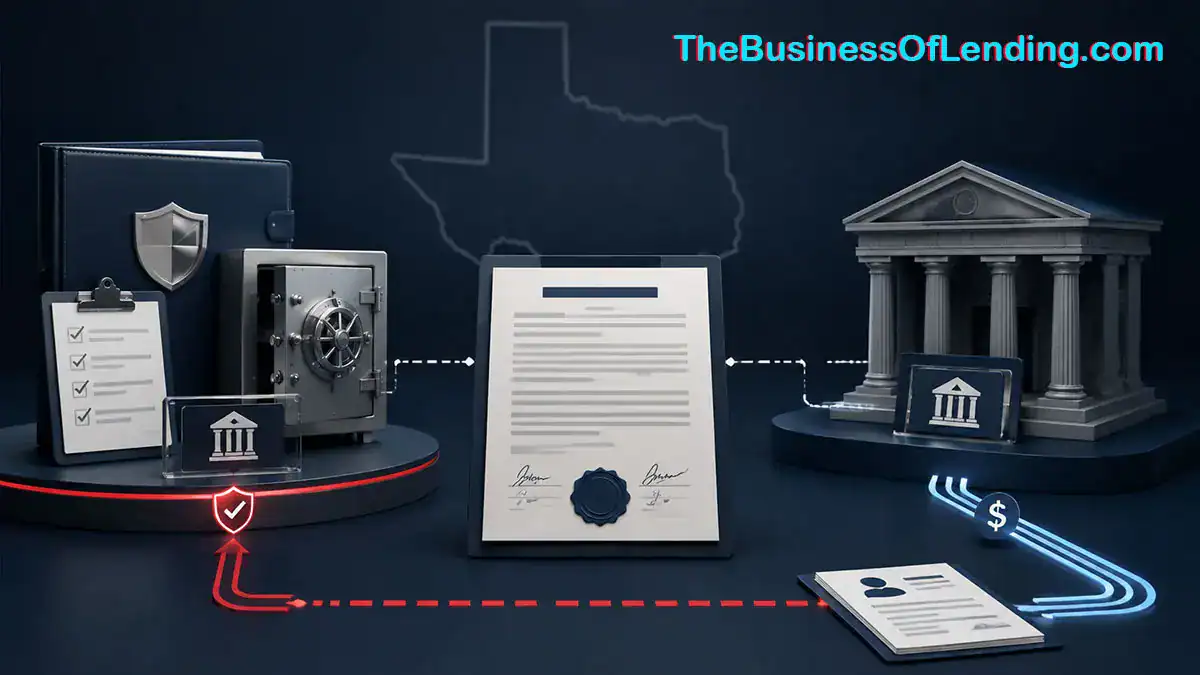
A Texas CAB third-party lender agreement is the contract set that splits a consumer loan into two separate businesses: the licensed Credit Access Business (CAB) that brokers and guarantees the loan, and the unlicensed third-party lender that funds it.
The CAB holds the OCCC license and charges the fee.
The lender puts up the money of record.
On paper the lender makes the loan.
In practice, the CAB bears the credit risk because it guarantees every loan and posts cash collateral to back that guarantee.
Read that last sentence again.
It is the whole game.
Most people looking at this model think the “third-party lender” is the one taking the risk.
They have it backwards, and that misunderstanding is exactly where new operators get crushed.
What a Texas CAB actually is
A Credit Access Business, sometimes called a Credit Services Organization (CSO), is a licensed broker.
In Texas, the OCCC regulates the CAB.
The CAB does not make the loan. It arranges the loan through a third-party lender and charges the consumer a fee for the service.
That fee is the point.
Because the CAB is a broker, its fee is not treated as interest, so it is not capped by usury limits the way a direct loan would be.
The Fifth Circuit upheld this structure in Lovick v. RiteMoney, Ltd. (5th Cir. 2004): a bona fide CSO broker fee is not usurious interest.
The average CAB fee runs $20 to $30 per $100 borrowed. That is where the margin lives.
The consumer signs two documents at the same counter: a promissory note with the lender for the loan proceeds, and a separate credit services agreement with the CAB for the fee.
Two entities. Two contracts. One transaction. Keep those two entities genuinely separate, or the whole structure is exposed.
Want the full model, the sample agreements, and the due-diligence checklist for acquiring an existing CAB?
The two entities, and which chair you are sitting in
Here is the part nobody explains cleanly.
The third-party lender does not lend you money to run your business.
You bring your own capital.
The lender holds it as collateral, then funds loans against it.
People hear “third-party lender” and picture an outside bankroll absorbing the losses.
Wrong.
Your capital secures the guaranty, and your guaranty absorbs the defaults.
So, before you read a single clause, answer one question: are you the CAB or the lender?
Because the documents protect the lender and obligate the CAB, and if you do not know which chair you are in, you will sign obligations you did not price.
The 7 documents in a Texas CAB third-party lender agreement
A complete program is not one contract. It is a stack. Miss one piece and the model does not hold.
Here is the stack, in plain English.
1. Credit Services Agreement (CSA). The master contract between the CAB and the lender. It defines the Program, the roles, the obligations of each side, the term, and how the relationship ends. Every other document points back to this one.
2. Program Guidelines (Schedule 1). The operating manual. It spells out the application workflow, who hands the consumer what, and the required disclosures: the Consumer Transaction Information disclosure under Texas Finance Code 393.223, the CAB privacy policy, the Credit Services Disclosure Statement, the Notice of Cancellation, and the Notice of Adverse Action when a loan is declined. This is the document your storefront staff actually live inside.
3. Program Guidelines Letter Agreement. The short letter that formally adopts the guidelines and attaches the Loan Terms. Read one line carefully: the Loan Terms are set by the lender and are not subject to the CAB’s approval. You broker and guarantee loans on terms the lender controls. Sit with that.
4. Underwriting Criteria (Schedule 2). The lender’s rules for who gets funded, “in the lender’s sole and absolute discretion.” Deny if the applicant is in current bankruptcy. Deny if they are a current write-off. Deny if they are on the OFAC watch list. Deny if the CAB has not issued a guaranty. That last rule is the tell: no guaranty from you, no loan from them.
5. CAB Guaranty. The heart of the model. The CAB unconditionally guarantees the lender the prompt payment of every loan, principal, interest, late fees, and up to $30 of NSF fees. It holds even if the consumer cancels the credit services contract. You are not a broker who walks away at funding. You are on the hook for the money.
6. Collateral Agreement. How the guaranty gets funded. The CAB deposits cash into an account the lender controls, with a UCC security interest in the lender’s favor. When a loan defaults, the lender deducts the guaranteed amount straight from your deposit. Then you replenish the deficit, often within one business day. Miss that window and you are in default of your own agreement.
7. Master Assignment of Promissory Notes. The cleanup mechanism. When a loan defaults and you pay the guaranty, the defaulted note is assigned back to the CAB, without recourse, so you own the paper and collect it yourself. You paid for it. Now you chase it.
Put the seven together, and the machine is obvious: the lender funds against your collateral, sets the terms, and stays protected.
You broker, you guarantee, you fund the reserve, you eat the defaults, and you keep the fee.
The fee is your yield. The
defaults are your risk.
That trade can be a good business.
It is a terrible surprise.
Who really carries the risk
| Role | The CAB (you, usually) | The Third-Party Lender |
|---|---|---|
| License | Licensed by Texas OCCC | Generally unlicensed in Texas |
| Sets loan terms & underwriting | No (limited influence) | Yes, sole discretion |
| Earns the fee | Yes, the CAB fee ($20-$30 per $100 avg) | Earns a return on funded capital |
| Guarantees the loan | Yes, principal, interest, fees, up to $30 NSF | No, protected by the guaranty |
| Posts cash collateral | Yes, into a lender-controlled account | No, holds the collateral |
| Carries the credit risk | Yes | Largely protected |
| Owns defaulted notes | Yes, assigned back to collect | No |
The lender’s downside is capped by your collateral and your guaranty.
Your downside is the loan book.
If your underwriting is loose, your defaults climb, your deposit drains, and you are wiring cash to replenish it on one business day’s notice.
The lender still gets paid. That is the deal you signed.
This is why the “lender sets underwriting, CAB eats losses” split is the most dangerous clause in the stack.
The party writing the credit rules is not the party absorbing the credit losses.
If you are the CAB and you do not have real influence over the criteria and the loan terms, you are guaranteeing a book someone else is steering.
Price that gap before you sign, or negotiate a seat at the underwriting table.
Where new operators get crushed
Three failures show up again and again.
They blur the two entities.
Same staff, same bank account, same signage, no real separation.
When the entities are not genuinely independent, the broker-fee defense gets weaker, and the usury exposure gets real.
The separation is not paperwork theater.
It is the load-bearing wall.
They undercapitalize the reserve.
Operators size the collateral deposit for a good month, then get buried when defaults cluster, and the replenishment notices stack up.
Model your reserve against a bad month, not an average one, because the one-business-day clock does not care about your excuses.
They think the fee is free money.
It is not.
The fee is compensation for carrying the credit risk on a subprime book.
If you roll borrowers with no principal paydown to juice the fee, you are not running a lending business; you are running a trap that eventually runs you.
The loan has to move the borrower forward. That is both the ethical line and the durable business.
The 2026 NMLS transition changes your filing, not the model
One timing item every Texas CAB operator needs on the calendar.
The OCCC is moving CAB licensing off its old ALECS system and onto the Nationwide Multistate Licensing System (NMLS).
The transition process began March 16, 2026. Unsubmitted CAB applications sitting in ALECS appear to have been deleted, so if you had a draft in progress, treat it as gone and rebuild it in NMLS. New applicants file through NMLS.
Existing licensees create an NMLS company account plus individual accounts for owners and controlling persons.
This is a continuity issue, not a legal-theory issue.
The model still works.
Your filing path changed.
Confirm the current OCCC guidance before you build your package, because transition dates and reporting systems are still moving.
Also, budget for the security requirement: Texas requires a surety bond or security account of $10,000 per location under Texas Finance Code sections 393.302 and 393.403, in favor of the State for the benefit of anyone harmed by a Chapter 393 violation. That is separate from the collateral you post to the lender.
Bottom line
A Texas CAB third-party lender agreement is not a form you download and sign.
It is a seven-document risk-transfer machine, and every clause moves risk toward the CAB and protection toward the lender.
Know which chair you are in, price the guarantee like it is real money, because it is, and never build this stack from a template.
This is the kind of structure that only holds up when it is drafted by an expert who has done it before. [Need a resource? Jer@theBusinessOfLending.com
If you are trying to build or acquire a Texas CAB and want the full model, including sample documents and the acquisition due diligence checklist, that is exactly what the Texas CAB/CSO analysis was built for.
And if you want a second set of eyes on an agreement already in front of you, book a call and bring the documents.
New Texas CAB rules, OCCC transitions, and operator breakdowns land in the newsletter first. 5,000+ lenders, attorneys, processors, and LMS providers read it.
Book a free 15-minute strategy call. Bring the agreement you are about to sign, or the entity you are about to buy, and we will pressure-test it together.
FAQ
Is a Texas CAB the same as a CSO? Yes. Credit Access Business (CAB) is the Texas term. Credit Services Organization (CSO) is the broader label used in Texas Finance Code Chapter 393 and in about 31 states. In Texas, the OCCC licenses and regulates CABs specifically. The terms are used interchangeably in this model.
Does the third-party lender need a Texas license? In the CAB model, the third-party lender is generally not licensed by the OCCC. The CAB holds the license and acts as the broker. This is the core reason the structure exists. That said, licensing rules and enforcement posture change, so confirm current requirements with a Texas attorney before you build.
Who carries the credit risk, the CAB or the lender? In a standard structure, the CAB does. The CAB guarantees each loan to the lender and posts cash collateral to back that guaranty, and defaulted notes are assigned to the CAB to collect. The lender is protected by the collateral and the guaranty. If you are the CAB, you are the one absorbing losses, which is why underwriting influence matters so much.
How much money do I need to start a Texas CAB? It varies with your loan volume, your product, and the collateral your lender requires, so there is no single number. Plan for the OCCC security requirement of $10,000 per location, the cash collateral deposit the lender demands, legal fees for the document set, software, staffing, and a default reserve sized for a bad month. Sizing that stack for a real deal is exactly what a strategy call is for.
Can I use a template for the CAB and lender agreements? No. This is a legal-drafting matter, and a generic template is how operators create usury and enforceability exposure. The seven documents have to work together and hold up under Texas law and OCCC scrutiny. Use counsel who has built this structure before. This article is education, not a substitute for that counsel.
What changed with the OCCC NMLS transition in 2026? CAB licensing is moving from the OCCC’s ALECS system to NMLS, with the transition beginning March 16, 2026. New applicants file in NMLS, existing licensees set up NMLS company and individual accounts, and in-progress ALECS drafts may have been deleted. The model itself did not change, only the filing path. Confirm current OCCC guidance before you file.
The Texas CAB/CSO Model Explained
The full model, sample documents, and acquisition due-diligence checklist.
How to Start a Car Title Loan Business
The product many CAB operators run on top of the third-party lender structure.
Consulting With Jer Ayles
Bring the agreement you are about to sign. We pressure-test it together.
The Business of Lending Newsletter
OCCC transitions, CAB rule changes, and operator breakdowns, first.
Written by Jer Ayles | 20+ years in consumer lending | Built and sold 15 storefront lending locations | About