
Subprime Loan Business in 2026. Demand is Strong, but Weak Paper Kills Profit
2026 Operator Briefing for Subprime Lenders
Subprime Payday, Car Title, Installment Loan Business in 2026. Demand is Strong, but Weak Paper Kills Profit
Payday, car title, installment, and Texas CAB lenders still have demand. The lenders who will win will approve better, document better, collect earlier, and stop pretending volume alone is strategy.
Operator Answer
The Problem is Not demand. It's Bad Paper
The Short Version
A subprime loan business can still find demand among borrowers in 2026, especially for payday loans, car title loans, installment loans, and other short-term credit models.
The problem is not demand. The problem is funding borrowers whose cash flow, documentation, payment structure, and collection path cannot support the loan.
Operators who win in 2026 will approve better, document better, and collect earlier.
What Is a Subprime Loan Business?
A subprime loan business serves borrowers who may not qualify for traditional bank credit because of damaged credit, thin credit history, unstable income, limited savings, or urgent cash needs.
Common subprime lending models include:
- Payday loans
- Car title loans
- Installment loans
- Line-of-credit products
- Texas CAB/CSO loans
- Online small-dollar loans
- Storefront consumer loans
The business is not simply “lending money to people with bad credit.” The real business is underwriting repayment behavior, pricing risk legally, documenting the file, collecting payments, managing complaints, and protecting margin after funding.
2026 DATA POINTS FOR LENDERS
Emergency expenses
Federal Reserve household finance data. Add Visible source link
$400 emergency gap
Use Fed emergency expense table. Add visible link
Household delinquency
Use New York Fed debt and credit data. Add visible link
High APR ad restrictions
Use Google Ads personal loans policy. Add visible source link
A subprime loan business serves borrowers who may not qualify for traditional bank credit because of damaged credit, thin credit history, unstable income, limited savings, or urgent cash needs.
Common subprime lending models include:
- Payday loans
- Car title loans
- Installment loans
- Line-of-credit products
- Texas CAB/CSO loans
- Online small-dollar loans
- Storefront consumer loans
The business is not simply “lending money to people with bad credit.” The real business is underwriting repayment behavior, pricing risk legally, documenting the file, collecting payments, managing complaints, and protecting margin after funding.
If you want to start a subprime loan business, or fix one that is already leaking money, understand this first:
Borrower demand is not the problem.
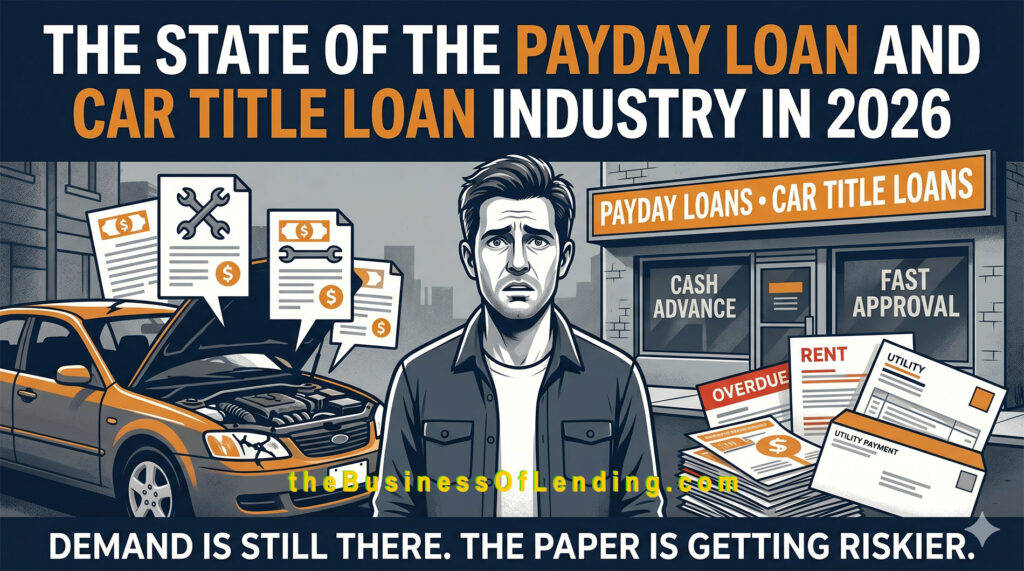
Working people are still getting hit with car repairs, medical bills, rent gaps, utility notices, and broken paychecks. The need is still there.
The danger is believing that need automatically turns into profit.
It does not.
In 2026, the operators who win in payday lending, car title lending, and other short-term credit models will not be the ones who simply fund more loans.
They will be the ones who fund cleaner loans, document better, collect earlier, and stop pretending a busy phone means a healthy business.
TLDR:
What Is a Subprime Loan Business?
A subprime loan business serves borrowers who may not qualify for traditional bank credit because of damaged credit, thin credit history, unstable income, limited savings, or urgent cash needs.
Common subprime lending models include:
- Payday loans
- Car title loans
- Installment loans
- Line-of-credit products
- Texas CAB/CSO loans
- Online small-dollar loans
- Storefront consumer loans
The business is not simply “lending money to people with bad credit.” The real business is underwriting repayment behavior, pricing risk legally, documenting the file, collecting payments, managing complaints, and protecting margin after funding.
Decision Path
- Starting from zero? Prove the model, licensing path, funding source, acquisition plan, and collections system before you spend real money.
- Already operating? Audit early defaults, returned payments, payment plans, complaints, lead quality, and staff execution.
- Trying to grow? Do not scale a sloppy book. Fix the engine first.
If you are serious about building or improving a subprime loan business:
1: Grab your copy of our “Bible, How to Loan Money to the Masses without Getting Your Btt Handed to You.”
2. Start with your numbers.
Pull your last 60 to 90 days of funded loans, returns, first-payment defaults, charge-offs, renewals, complaints, and acquisition sources.
That file will tell you more than any other motivational business podcast ever will.
Brand: The Business of Lending
Author: Jer Ayles
Service: Operator education for people starting, buying, or improving subprime lending businesses
Topic: 2026 payday loan, car title loan, and subprime lending business conditions
Audience: Current lenders, future lenders, investors, managers, and operators trying to protect margin and avoid expensive mistakes
Who This Is For
This is for the person thinking about opening a payday loan, title loan, installment loan, or other subprime lending operation.
It is also for the owner who already has a loan book and knows something feels off.
Applications are coming in.
Customers still need money.
The phones may be ringing.
But the paper feels touchier.
That is the part that matters.
If you confuse demand with profit, this business will teach you the lesson the expensive way.
The Real 2026 Setup For A Subprime Loan Business
A subprime loan business serves borrowers who often do not have many clean credit options. These customers may be employed, banked, and trying to solve a real cash problem, but they may also be dealing with thin savings, uneven income, prior credit damage, or competing payment obligations.
That is the business.
Not fantasy lending.
Not spreadsheet lending.
Real people with real emergencies and limited room for error.
The Federal Reserve’s 2025 household report shows why demand is still present. It reported that 59% of adults had at least one major unexpected expense in the prior 12 months. Vehicle repair or replacement was the most common major expense at 30%.
For title lenders, that vehicle number matters.
A car problem is not just a repair bill.
For many borrowers, it is a work problem.
If the vehicle goes down, income can go down with it. That is why car title loan demand can remain strong even when the broader economy looks fine on paper. The borrower may not be trying to upgrade a lifestyle. The borrower may be trying to stay mobile enough to keep earning.
That is the demand side.
Now here is the operator side:
Demand does not pay your bills.
Collections do.
Demand Is Not Profit
The same Federal Reserve report said 30% of adults had income that varied at least occasionally from month to month, and 11% said income variability caused them to struggle to pay bills in the prior year.
The New York Fed reported that 4.8% of outstanding household debt was in some stage of delinquency in Q1 2026.
That is the setup.
The borrower still needs the product.
But a larger piece of the borrower pool may be financially fragile.
If you answer that by loosening standards, you may book volume and hate your portfolio 30 to 60 days later.
Read that again.
A bad loan does not become good because the customer needed the money.
A weak payment does not become collectible because the phone rang.
A sloppy file does not become defensible because the store was busy.
The real question is not, “Is there demand?”
The real question is, “Can you fund this demand without wrecking margin?”
How A Better Subprime Lending Operation Works
A good subprime lending operation is not built around hope.
It is built around controls.
1. Start With The Borrower’s Cash Flow
Credit score has a place, but this business lives in cash flow.
You need to know:
- How the borrower gets paid
- How often the borrower gets paid
- Whether income is steady or variable
- What deposits are normal
- What changed recently
- What other lenders or payment obligations are already hitting the account
If the borrower’s income is bouncing around, your payment design needs to respect that reality.
2. Review The Bank Activity Like An Operator
Bank review is not a box-checking exercise.
Look for the ugly middle:
- Returned payments
- Overdraft pressure
- Deposit gaps
- Stacked loan payments
- Gambling patterns
- Payroll inconsistency
- Rent, utility, or car-payment stress
- Prior lender activity
- Unusual transfers
You are not looking for a perfect borrower.
You are looking for a borrower whose repayment path makes sense.
3. Size The Payment To Reality
A payment can be legal and still be dumb.
A payment can fit the contract and still fail in the real world.
This is where inexperienced operators get hurt. They price for the model, not for the borrower’s actual cash flow.
If the payment amount is too heavy, collections inherits the mistake.
4. Treat Collections As Part Of Origination
Collections does not start when the loan goes bad.
It starts at origination.
It starts with:
- Product structure
- Payment schedule
- Clear explanation
- Written documentation
- Borrower expectations
- Payment authorization process
- Staff training
- Follow-up cadence
The CFPB’s payday rule page states that the Bureau revoked the mandatory underwriting provisions, but the rule still addresses payment practices for payday loans, vehicle title loans, and certain high-cost installment loans.
Translation for operators:
Do not treat payments like paperwork.
Treat payments like operations.
Requirements Checklist Before You Start Or Grow
Before you start a subprime loan business, or add more volume to one you already run, review this checklist:
- State licensing requirements
- Product type allowed in each target state
- Rate, fee, term, and loan amount rules
- Legal review from qualified counsel
- Funding source and cost of capital
- Written underwriting policy
- Income verification process
- Bank review process
- Fraud screening process
- Payment authorization procedures
- Collections policy
- Complaint handling process
- Staff training materials
- Loan management software
- Storefront or online acquisition plan
- Lead source review
- Marketing policy review
- Compliance calendar
- Portfolio reporting
- Cash reserve plan
- Exit plan for bad products, bad states, or bad vendors
If that feels boring, good.
Boring protects margin.
Sloppy gets expensive.
The Acquisition Problem Nobody Wants To Admit
Customer acquisition is still a fight.
Google’s policy says it does not allow ads for personal loans with an APR of 36% or above in the United States. That policy applies to direct lenders, lead generators, and parties that connect consumers with third-party lenders.
That matters for high-cost credit operators.
You cannot assume paid search will bail you out.
So what matters?
Local intent.
Organic traffic.
Repeat customers.
Referral paths.
Brand trust.
A clean reputation.
A website that answers real borrower and operator questions.
A lending business without distribution is not a business.
It is a hobby with expenses.
| Operator situation | Main temptation | Real danger | Better move |
|---|---|---|---|
| Starting from zero | Open fast and figure it out later | Licensing, funding, software, compliance, and collections mistakes | Build the model on paper first |
| Existing store | Fund more because demand is visible | Early defaults and weak payment performance | Review underwriting and payment sizing |
| Online lender | Buy more leads | Fraud, low intent, weak conversion, compliance exposure | Audit lead quality and funnel controls |
| Title lender | Chase collateral value | Borrower cash flow still drives repayment | Review income, vehicle use, and payment fit |
| Growing operator | Add locations or states | Scaling broken process | Fix reporting, training, and controls first |
The Texas Reminder: Admin Is Margin Protection
Texas still matters, and so do the details.
The Texas OCCC says the Credit Access Business transition to NMLS is underway and that the transition remains open until May 18, 2026. {Whoops, this date has passed. Skip licensing via the Texas OCCC. Proceed to the NMLS.
That is not trivia.
That is the kind of operational detail that separates operators from tourists.
Licensing, renewals, notices, documents, payment rules, and file standards may feel like back-office clutter.
They are not.
They are margin protection.
A subprime lending business has enough risk built into the model. Do not add avoidable risk because nobody owned the checklist.
The Operator Reality Check
- Process pitfalls: A lending business breaks when the front-end process is sloppy.
- Compliance risk: Product rules, payment rules, licensing, and disclosures vary by state and can change.
- Margin leaks: Bad payment sizing, poor lead quality, weak collections, and fraud can eat the business fast.
- Training and documentation: Staff cannot run a process that only exists in the owner’s head.
- Results vary: No lending model, software, market, or training path guarantees profit.
Related Reading on The Business of Lending
Risks And Common Mistakes
Mistake 1: Thinking The Business Is Just Funding
Funding is the start.
The business is repayment.
If you do not understand late payments, returned ACH, roll rates, charge-offs, complaints, and collections friction, you do not understand the business yet.
Mistake 2: Building Around Best-Case Math
If the model only works when every borrower pays perfectly, the model does not work.
Real lending has friction.
Returned payments.
Broken promises.
Bad files.
Staff mistakes.
Regulatory pressure.
Customer complaints.
Fraud.
If your plan cannot survive that, it is not a plan.
Mistake 3: Buying Leads Before You Know Your Numbers
Lead buying can make a bad operator feel busy.
That is dangerous.
Before you buy more traffic, know your numbers:
- Application cost
- Funded loan cost
- First-payment default rate
- Return rate
- Renewal rate, where allowed
- Net charge-off trend
- Complaint rate
- Cost per performing customer
- Revenue by source
- Profit by source
If you do not know source-level performance, you are guessing.
Mistake 4: Treating Compliance Like A Speed Bump
Compliance is not a department you call after the idea is already built.
It should shape the product.
It should shape the marketing.
It should shape the documentation.
It should shape collections.
You do not need fear.
You need discipline.
Mistake 5: Scaling Before The Engine Works
One broken store is a problem.
Ten broken stores is a crisis with signage.
One weak online funnel is annoying.
A scaled weak funnel is a cash bonfire.
Fix the unit before you multiply the mistake.
Quick Start Checklist
If you are starting or improving a subprime loan business, do this first:
- Pick the product type and states you are actually evaluating.
- Confirm the licensing and legal path with qualified counsel.
- Build a conservative unit model.
- Define underwriting rules in writing.
- Define payment sizing rules in writing.
- Select software only after you understand the workflow.
- Build collections procedures before funding loans.
- Decide how you will acquire customers without depending on one fragile channel.
- Create reporting for early defaults, returns, complaints, and charge-offs.
- Train staff from written standards, not owner memory.
The Bottom Line
The borrower is still there.
The emergency is still there.
The demand is still there.
But the paper is not getting easier.
Some lenders will mistake a busy phone for a healthy business.
That is a mistake.
The operators who should do best in 2026 are the ones who stay tight.
Tight on underwriting.
Tight on payment sizing.
Tight on collections.
Tight on acquisition.
Tight on compliance.
This is not the season to get aggressive in dumb ways.
This is the season to build the lending business like it has to survive a bad month.
Because it does.
Frequently Asked Questions
Is 2026 a good time to start a subprime loan business?
It can be an opportunity, but only for operators who understand the risk. Demand for short-term credit may remain strong because many households still face emergency expenses and limited savings. That does not mean every market, product, or model makes sense. Licensing, compliance, funding, underwriting, collections, and acquisition need to be reviewed before you spend serious money.
What is the biggest mistake new subprime lenders make?
The biggest mistake is thinking the business is about funding loans. It is not. The business is about funding loans that can be repaid under a process you can document, service, and defend. Weak underwriting and sloppy payment structure can create problems fast.
Why does car repair data matter for title lenders?
Vehicle repairs matter because a car is often tied directly to income. If the borrower cannot drive to work, the borrower’s ability to earn may be affected. That can create demand for title loans, but it also means the operator must review repayment ability carefully.
Do payday and title lenders still need to worry about compliance?
Yes. Compliance rules vary by state and product type. Licensing, disclosures, payment practices, marketing, renewals, collections, and complaint handling all matter. Operators should work with qualified counsel and compliance professionals before launching or changing a lending model.
Why is customer acquisition harder for high-cost lenders?
Some advertising channels restrict high-cost personal loan advertising. Google states that it does not allow ads for personal loans with an APR of 36% or above in the United States, including direct lenders and lead generators. That makes local reputation, organic visibility, referrals, repeat customers, and owned traffic more important.
What numbers should an existing lender review first?
Start with funded loans, first-payment defaults, returned payments, charge-offs, payment plans, complaints, renewals where allowed, and performance by acquisition source. Do not just review total volume. Review quality of volume.
Can better underwriting hurt growth?
It can reduce weak approvals, but that is not always bad. More volume is not useful if the book performs poorly. The goal is not to approve everyone. The goal is to build a lending operation that can survive real borrower behavior.
What should I do before buying leads for a lending business?
Know your unit economics first. Track cost per application, cost per funded loan, first-payment default rate, repayment performance, complaint rate, and profit by source. Buying more leads before you understand those numbers can make the business look active while margin leaks out the back door.
Want to Build This Business Without Learning Every Lesson the Expensive Way?
If you are serious about starting or improving a subprime lending business, do not wing it.
The demand is there. The borrower is there. The opportunity is there.
But this business will punish sloppy operators fast.
How to Loan Money to the Masses Without Getting Your Butt Handed to You is the operator bible for people who want to understand the real mechanics of lending, underwriting, collections, compliance pressure, cash flow, and margin before the mistakes get expensive.
This is not theory. It is a field guide for people who want to think like lenders, not tourists.
Educational material only. Results vary. Lending laws and licensing rules vary by state and business model. Get qualified legal and compliance guidance before operating.